Abstract
This disclosure describes a powered hand tool incorporating a vibration reduction system that decouples the handle from the tool body through a tuned mass path. The system addresses the problem of hand-arm vibration exposure, which typically limits the duration of tool use long before component wear dictates replacement. By strategically integrating an inertial mass and elastic elements, the design attenuates vibration energy within specific frequency bands, primarily those associated with common tool operation. This arrangement aims to improve user comfort and control, enabling extended periods of operation while maintaining necessary tool functionality across various working orientations.
1. Technical Field
[0001]This disclosure relates to powered hand tools, specifically to arrangements for reducing the transmission of mechanical vibration from the active components of the tool to the operator's hand and arm. The technical field encompasses mechanisms designed to mitigate vibration exposure, thereby addressing ergonomic factors associated with prolonged tool use.
2. Technical Context
[0002]Powered hand tools inherently generate mechanical vibrations during operation due to the actions of motors, gears, impact mechanisms, or cutting elements. These vibrations are transmitted through the tool body (10) to the handle assembly (16) and subsequently to the operator. Prolonged exposure to hand-arm vibration can lead to discomfort, fatigue, and cumulative trauma disorders, which may limit the effective operational time of the tool for an individual user. Regulatory and health guidelines often specify limits for vibration exposure, meaning that a tool's usable trigger time might be significantly constrained by ergonomic considerations long before its mechanical components reach their end-of-life or require maintenance. The challenge is to reduce the vibration transmitted to the operator without compromising the tool's performance, balance, or user control.
3. System Overview
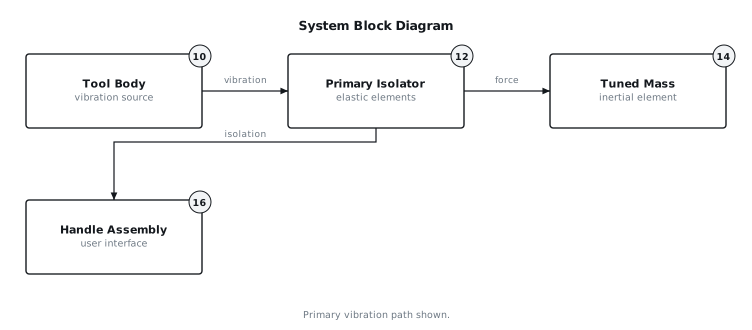
[0003]The described arrangement integrates a vibration reduction system directly into the structure of a powered hand tool. As shown in FIG. 1, the system effectively decouples the handle assembly (16) from the primary vibration sources within the tool body (10). This decoupling is achieved by introducing a tuned mass (14) into the vibration transmission path, supported by primary isolator elements (12) and secondary elastic elements (22) which also support the handle assembly (16). The tuned mass (14) is designed to resonate at or near the dominant frequencies of vibration generated by the tool, thereby absorbing and dissipating a substantial portion of the vibration energy before it reaches the operator's hand. The overall system provides both passive isolation and resonant absorption to attenuate vibrations within a target frequency band.
4. Components
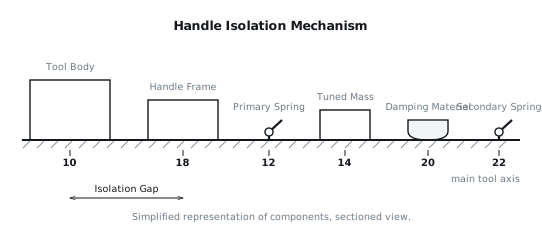
[0004]The vibration reduction system comprises several key components, as depicted in FIG. 2:
[0005]
- Tool Body (10): This is the main housing of the powered hand tool, containing the motor, transmission, and active working components (e.g., impact mechanism, blade, sanding pad). It is the source of the mechanical vibrations that the system aims to mitigate.
- Handle Assembly (16): This is the part of the tool that the operator grips during use. It is designed to be largely isolated from the tool body (10) by the vibration reduction system. The handle frame (18) forms the structural core of the handle assembly (16).
- Primary Isolator (12): This component consists of one or more elastic elements, such as helical springs, leaf springs, or elastomeric mounts, positioned between the tool body (10) and the handle assembly (16). Its primary function is to provide a compliant interface that attenuates high-frequency vibrations and permits relative motion between the tool body (10) and the handle assembly (16).
- Tuned Mass (14): An inertial element, typically a dense block of material such as steel, tungsten alloy, or lead composite, precisely sized and positioned within the isolation system. The tuned mass (14) is mechanically linked to the handle assembly (16) and suspended by secondary elastic elements (22) to form a mass-spring system with a specific resonant frequency.
- Secondary Elastic Elements (22): These are springs or compliant material elements that support the tuned mass (14) relative to the handle frame (18). Their stiffness, in conjunction with the mass of the tuned mass (14), determines the resonant frequency of the tuned mass damper system.
- Damping Material (20): Viscoelastic materials, such as specific polymers or rubbers, integrated into the system to absorb energy and reduce the amplitude of resonance peaks. This material can be positioned alongside or within the primary isolator (12) or the secondary elastic elements (22), or as a dedicated component between the tuned mass (14) and the handle frame (18).
5. Operation
[0006]During operation, the powered hand tool generates vibrations within the tool body (10). These vibrations are transmitted towards the operator's hand through the handle assembly (16).
[0007]
- Start-up: When the tool is activated, the internal mechanisms begin to generate vibrational energy. The primary isolator (12) immediately begins to deflect, providing an initial level of isolation by absorbing some of this energy and preventing its direct transmission to the handle assembly (16).
- Steady Running: As the tool reaches steady operating speed, dominant vibration frequencies become established. The primary isolator (12) acts as a flexible connection, allowing relative motion between the tool body (10) and the handle assembly (16). Concurrently, the tuned mass (14), suspended by the secondary elastic elements (22) from the handle frame (18), begins to oscillate. If the dominant vibration frequencies from the tool body (10) fall within the target frequency band, the tuned mass (14) will be excited into resonance. This resonance causes the tuned mass (14) to oscillate out of phase with the handle assembly (16) at that specific frequency, effectively absorbing a significant portion of the vibrational energy that would otherwise be transmitted to the handle assembly (16). The damping material (20) dissipates some of this absorbed energy as heat, preventing excessive amplitude build-up in the tuned mass (14) and broadening the effective frequency range of attenuation. The net effect is a reduction in the amplitude of vibrations perceived by the operator.
- Fault or Interruption: In the event of a sudden impact, jam, or power interruption, the dynamic forces within the tool may change abruptly. The isolation system, including the primary isolator (12), tuned mass (14), and secondary elastic elements (22), is designed to accommodate these transient forces within its operational travel limits. Mechanical stops (not shown) are typically integrated to prevent over-travel of the handle assembly (16) relative to the tool body (10) or of the tuned mass (14) relative to the handle frame (18) during extreme events, thereby protecting the elastic components. Upon cessation of operation, the system returns to its static equilibrium position.
[0008]The effect on tool feel and control is primarily that the operator experiences a reduction in high-frequency, high-amplitude vibrations. This enables a more consistent grip force and improved precision during tasks, as the oscillatory motion transmitted to the hand is minimized. Control is enhanced by reducing hand fatigue and the tendency for the tool to "walk" or deviate from the intended path due to vibration.
[0009]When the tool is used overhead, the orientation of the tuned mass (14) and its gravitational vector changes relative to the primary vibration axis. While the gravitational force will alter the static equilibrium position of the tuned mass (14) slightly, the dynamic behavior of the tuned mass (14) as a resonant system is largely unaffected by static orientation changes. The resonant frequency is determined by the mass and stiffness of the secondary elastic elements (22). However, the effective damping and isolation might be minimally influenced by the direction of the vibrational forces relative to the compliant axes of the isolators. The system is designed to provide effective attenuation across various working orientations, including overhead use, by ensuring the isolation mechanism functions irrespective of gravity's influence on the tuned mass's static position.
6. Example Embodiments
[0010]Embodiment 1 In this configuration, the primary isolator (12) consists of four helical compression springs arranged symmetrically around the tool's longitudinal axis, supporting the handle frame (18) from the tool body (10). The tuned mass (14) is a rectangular steel block centrally located within the handle frame (18) and suspended by two leaf springs, acting as the secondary elastic elements (22). The leaf springs are oriented to allow vertical oscillation of the tuned mass (14) with respect to the handle frame (18). Damping material (20) is integrated as elastomeric pads on the contact surfaces between the tuned mass (14) and internal structures of the handle frame (18) to limit travel and provide additional energy dissipation. This embodiment is suitable for tools generating dominant vertical vibrations, such as rotary hammers or reciprocating saws.
[0011]Embodiment 2 This embodiment features a handle assembly (16) connected to the tool body (10) via elastomeric bushes serving as the primary isolator (12). These bushes allow rotational compliance around a pivot point, effectively isolating angular vibrations. The tuned mass (14) is positioned within a cavity in the handle frame (18), closer to the user's grip. It is supported by two tension springs acting as the secondary elastic elements (22), allowing it to oscillate horizontally, perpendicular to the main tool axis. Viscous damping fluid within a small sealed chamber (not shown) provides the damping material (20) for the tuned mass (14). This arrangement is particularly effective for tools with significant lateral vibration components, such as angle grinders or some types of sanders.
[0012]Embodiment 3 In this embodiment, the entire handle assembly (16) is attached to the tool body (10) through a linkage system comprising multiple compliant arms, which collectively form the primary isolator (12). This linkage permits motion of the handle assembly (16) in multiple translational and rotational degrees of freedom relative to the tool body (10). The tuned mass (14) is implemented as a series of smaller, distributed masses (each having a reference numeral of 14, but representing multiple distinct masses) embedded within the grip portion of the handle assembly (16). Each individual mass (14) is supported by a small elastomeric mount (22) tuned to a slightly different resonant frequency, creating a broad-band absorption effect. The elastomeric mounts also provide inherent damping (20). This configuration is designed for tools with a wide spectrum of vibration frequencies or complex multi-directional vibrations, such as demolition hammers or high-speed chippers.
7. Alternative Configurations
[0013]The primary isolator (12) can be implemented using various compliant mechanisms beyond simple springs or bushes, such as scissor linkages with elastomeric pivots, or hydraulic/pneumatic cylinders providing spring and damping functions. The tuned mass (14) itself can be composed of multiple smaller masses, each tuned to a distinct frequency within the target band, or a single mass with variable stiffness elements to allow for adjustment of the resonant frequency. The location of the tuned mass (14) can vary, being placed within the handle, directly on the tool body (10) but connected to the handle assembly (16) via a lever, or even as part of the tool's working mechanism if feasible. The damping material (20) could be a magnetorheological fluid whose viscosity can be actively controlled to adjust damping levels, or passive arrangements like friction elements.
8. Parameter Variations
| Parameter | Realistic Range | Effect of Increasing Value | Effect of Decreasing Value |
|---|---|---|---|
| Tuned Mass (14) Mass | 0.05 kg to 0.5 kg | Lowers resonant frequency; improves low-frequency absorption. | Raises resonant frequency; less effective at low frequencies. |
| Secondary Spring (22) Stiffness | 50 N/m to 5000 N/m | Raises resonant frequency; reduces travel. | Lowers resonant frequency; increases travel. |
| Damping Material (20) Factor | 0.05 to 0.5 (dimensionless) | Broadens absorption bandwidth; reduces peak amplitude. | Narrows absorption bandwidth; increases peak amplitude. |
| Primary Isolator (12) Stiffness | 1000 N/m to 10000 N/m | Reduces static deflection; transmits more high-frequency vibration. | Increases static deflection; improves high-frequency isolation. |
| Isolation Gap (FIG. 2) | 5 mm to 20 mm | Allows greater relative movement; reduces risk of bottoming out. | Restricts relative movement; increases risk of bottoming out. |
9. Additional Implementations
[0015]Beyond hand tools, the principles of decoupling a user interface from a vibration source via a tuned mass path can be applied to other human-machine interfaces. This includes control levers or joysticks on heavy machinery, steering wheels in vehicles, or even fixed workbenches where vibrating equipment is mounted. The tuned mass (14) could be actively controlled using electromechanical actuators to dynamically adjust its resonant frequency in response to varying tool operation modes or vibration spectra. Furthermore, the handle assembly (16) itself could integrate sensors to measure the residual vibration transmitted to the operator, providing feedback for adaptive tuning of the tuned mass system. The handle's grip surface could also be engineered with specific viscoelastic properties to further absorb high-frequency, low-amplitude vibrations that are not fully attenuated by the primary isolation and tuned mass elements.
10. Figures