Abstract
This disclosure describes a two-stage belt cleaning system designed to minimize carryback on conveyor belts. A primary scraper removes bulk material, while a secondary scraper, mounted on a compliant mechanism, removes finer particles and moisture. The compliant mount enables the secondary blade to maintain consistent contact pressure against the belt surface despite irregularities and wear, preventing material accumulation under the return run and mitigating potential belt damage. The system addresses blade wear management, accommodates belt splices, and maintains cleaning effectiveness on reversing belts.
1. Technical Field
[0001]The technical field is industrial bulk material handling, specifically concerning systems for cleaning conveyor belts used to transport particulate or granular materials. This disclosure relates to mechanical scraping devices designed to remove residual material from the surface of a conveyor belt as it returns to the loading point.
2. Technical Context
[0002]Conveyor belts are widely utilized for bulk material transport. After material is discharged from the head pulley, a certain amount of residual material, termed "carryback," adheres to the belt surface. If not effectively removed, this carryback can fall off the belt along the return path, accumulating under the conveyor structure, on idlers (40), and around the tail pulley. This accumulation can lead to operational issues such as belt misalignment, premature wear of idlers and bearings, and damage to the conveyor belt (10) itself. Furthermore, collected material often requires manual cleanup, incurring labor costs and potential safety hazards. Traditional single-stage belt cleaners may remove the majority of carryback but often leave a fine layer or moist residue that can still cause problems. The problem intensifies with sticky or wet materials, which adhere more tenaciously. The need exists for an improved cleaning system that provides comprehensive removal of both bulk and fine carryback, while also accommodating the operational characteristics of conveyor belts, including splices and potential reversal of direction.
3. System Overview
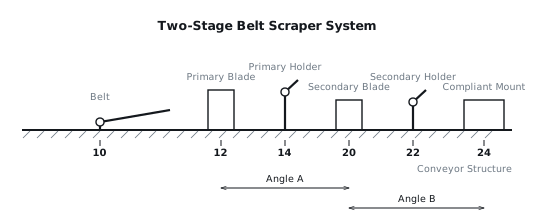
[0003]The disclosed system comprises a two-stage belt cleaning arrangement positioned after the discharge point of a conveyor belt (10). The first stage employs a primary scraper blade (12) designed to remove the majority of bulk carryback material (34). Following the primary stage, a secondary scraper blade (20) is installed. This secondary blade (20) is distinctively mounted on a compliant mechanism (24), which ensures continuous, consistent contact with the belt (10) surface and effective removal of finer particles and moisture. Both stages are designed to operate without causing damage to the belt (10) or its splices (52). The compliant mount (24) for the secondary blade (20) allows it to conform to belt irregularities and absorb impacts, while also compensating for blade wear. The entire system is engineered to handle various belt speeds and material types, and to function effectively even when the conveyor belt (10) operates in reverse. FIG. 1 illustrates an elevation view of the two-stage belt scraper system.
4. Components
[0004]The cleaning system consists of several key components:
[0005]
- Conveyor Belt (10): The moving surface from which carryback material (34) is to be removed. It typically travels at speeds ranging from 0.5 m/s to 6 m/s.
- Primary Scraper Blade (12): This component is the first point of contact with the carryback material (34). It is typically constructed from a wear-resistant polymer or a ceramic-reinforced material. The blade (12) has a working edge angled to scrape material effectively.
- Primary Blade Holder (14): A structural element that secures the primary scraper blade (12) and connects it to the primary tensioning mechanism (16).
- Primary Tensioning Mechanism (16): This mechanism applies and maintains a specified contact pressure for the primary scraper blade (12) against the conveyor belt (10). It may incorporate springs, torsion bars (42), or pneumatic cylinders.
- Secondary Scraper Blade (20): Positioned downstream of the primary blade (12), this blade is typically made from a softer polymer, polyurethane, or a highly wear-resistant rubber compound. Its function is to remove fine particles and moisture left by the primary cleaner.
- Secondary Blade Holder (22): This component secures the secondary scraper blade (20) and attaches it to the compliant mount (24).
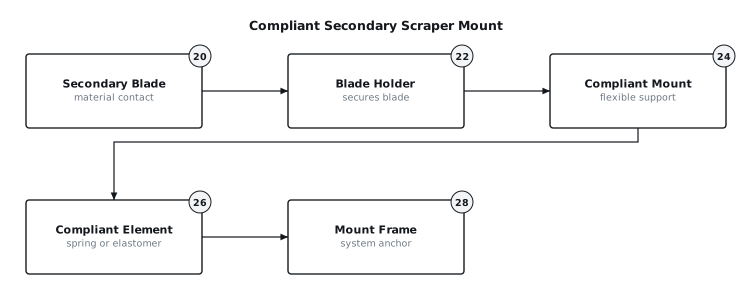
- Compliant Mount (24): A critical component providing flexibility and consistent pressure for the secondary blade (20). As shown in FIG. 2, it is composed of a flexible connection between the secondary blade holder (22) and the stationary mount frame (28).
- Compliant Element (26): Within the compliant mount (24), this element provides the necessary flexibility and spring action. It can be a rubber block, an elastomeric spring, a series of coil springs, or a torsion bar (42).
- Mount Frame (28): A rigid structure that supports both the primary and secondary cleaning stages and attaches them to the main conveyor support structure (30).
- Support Structure (30): The fixed framework of the conveyor system to which the cleaning assembly is mounted.
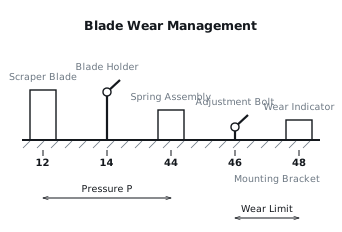
- Wear Indicator (48): A visual or electronic device, often integrated with the blade holder (14, 22) or tensioning mechanism (16), to monitor the wear level of the scraper blades (12, 20) and indicate when replacement or adjustment is due. This is illustrated in FIG. 3.
- Adjustment Bolt (46): A threaded fastener used to adjust the initial tension or position of the scraper blades (12, 20) against the belt (10), as depicted in FIG. 3.
5. Operation
[0006]The cleaning system operates continuously whenever the conveyor belt (10) is in motion.
[0007]Start-up: Upon initiation of belt (10) movement, the primary scraper blade (12) and secondary scraper blade (20) engage with the belt surface. The tensioning mechanisms (16) ensure that the blades (12, 20) apply the designed contact pressure. Any carryback material (34) present on the belt (10) from previous operation or accumulation is immediately engaged. The compliant mount (24) for the secondary blade (20) allows it to flex and seat properly against the belt (10) as it accelerates, absorbing initial shocks.
[0008]Steady Running: As the conveyor belt (10) moves past the cleaning station, carryback material (34) is first encountered by the primary scraper blade (12). This blade (12) is typically set with a negative rake angle, meaning its scraping edge points slightly opposite to the belt's direction of travel, typically between 5 and 15 degrees from vertical. The primary blade (12) exerts a contact pressure designed to dislodge the bulk of the material. This pressure might range from 0.07 N/mm to 0.2 N/mm of blade width, pushing the material downwards into a collection chute.
[0009]Immediately after the primary cleaning, the belt (10) passes under the secondary scraper blade (20). This blade (20) is typically set with a positive rake angle, meaning its scraping edge points slightly in the direction of belt travel, usually between 10 and 25 degrees from vertical. The compliant mount (24) ensures that the secondary blade (20) maintains a consistent and slightly higher contact pressure, for example, 0.1 N/mm to 0.3 N/mm of blade width. The compliant element (26) allows the blade (20) to float and follow minor undulations or irregularities in the belt (10) surface, ensuring optimal removal of fine particles and moisture. This action leaves the belt (10) surface as clean as practicable before it reaches the return idlers (40).
[0010]Blade wear is continuously taken up by the tensioning mechanisms (16) and the compliant mount (24). As the blades (12, 20) wear down, the spring force or pneumatic pressure of the tensioning mechanisms (16) pushes them further into contact with the belt (10), maintaining a relatively constant pressure. The wear indicator (48) provides a visual cue or signal when the blade (12, 20) has reached its minimum operational thickness or requires replacement.
[0011]Splice Clearance: When a mechanical splice (52) or a repaired section of the belt (10) passes through the cleaning station, the blades (12, 20) must navigate it without damage. The primary blade (12) is typically designed to allow the splice (52) to pass underneath without significant impact, often by using a segmented blade design or a material with sufficient flexibility. The compliant mount (24) of the secondary blade (20) is crucial here; its compliant element (26) compresses and allows the secondary blade (20) to lift and ride over the splice (52) with minimal force, then returns it to the operating position immediately after the splice (52) has passed. This temporary disengagement or yielding prevents snagging or damage to the splice (52) and avoids excessive wear on the blade (20). The compliant mount (24) is designed for a typical lift range of 5 mm to 15 mm to clear splices (52).
[0012]Fault or Interruption: In the event of a belt (10) stop, the blades (12, 20) remain in contact, preventing material from settling and adhering. If the belt (10) stops for an extended period, particularly with wet or sticky materials, manual cleaning of the blades (12, 20) might be performed if material build-up occurs. On restart, the blades (12, 20) re-engage as described above.
[0013]Reversing Belt Operation: For conveyor belts (10) designed for reversible operation, the cleaning system's behavior is critical. The primary scraper blade (12) and its holder (14) may be designed with a unidirectional scraping edge, which would require a second, identically configured primary blade (12) for the reverse direction, or a pivoting mechanism that re-orients the blade (12). The secondary scraper blade (20), due to its compliant mount (24) and the flexibility of its blade material, is often capable of effective cleaning in both forward and reverse directions without modification. When the belt (10) reverses, the positive rake angle of the secondary blade (20) effectively becomes a negative rake angle relative to the new direction of travel. The compliant mount (24) allows the blade (20) to articulate and maintain contact, scraping material off even when the primary function is performed by a dedicated reverse-direction primary cleaner or when the secondary blade (20) is the sole cleaner in reverse. For optimal reversing operation, the compliant element (26) of the secondary blade (20) can be configured to exert pressure equally in both directions of blade deflection.
6. Example Embodiments
[0014]Embodiment 1 This embodiment features a primary scraper blade (12) made of a tungsten carbide tip, segments of which are mounted on individual pivot arms, each with a rubber torsion element providing tension. The blade (12) is installed with a 10-degree negative rake angle. The secondary scraper blade (20) is a solid, one-piece polyurethane blade mounted in a holder (22) that is connected to the mount frame (28) via a series of independent elastomeric blocks serving as the compliant elements (26). Each block allows the segment of the blade (20) it supports to move independently in response to belt (10) irregularities. The secondary blade (20) maintains a 15-degree positive rake angle and a contact pressure of 0.25 N/mm.
[0015]Embodiment 2 In this configuration, the primary scraper blade (12) consists of a solid, heavy-duty polyurethane blade set at a fixed negative rake angle of 5 degrees, tensioned by a spring-loaded pivot arm mechanism (16) that provides 0.1 N/mm of pressure. The secondary scraper blade (20) is a segmented polyurethane blade, where each segment is individually mounted on a small, spring-loaded arm. These individual arms are then collectively attached to a main compliant mount (24) that utilizes a compressed air cylinder as its compliant element (26). This pneumatic system maintains a constant pressure of 0.2 N/mm on the secondary blade (20) segments and allows for precise pressure adjustment. The secondary blade (20) is set at a 20-degree positive rake angle.
[0016]Embodiment 3 This embodiment uses a primary scraper blade (12) made from a ceramic-polymer composite, mounted in a cassette system (14) that allows for quick blade (12) replacement. Tension is provided by a simple counterweight system (16) ensuring 0.15 N/mm pressure. The secondary scraper blade (20) is a highly flexible, thin rubber blade mounted on a compliant mount (24) comprising a series of flexible steel leaf springs (26). These springs (26) allow the blade (20) to conform closely to the belt (10) surface and ride over splices (52) with minimal impact. The secondary blade (20) operates at a 25-degree positive rake angle with approximately 0.18 N/mm contact pressure.
7. Alternative Configurations
[0017]The primary scraper blade (12) can be designed as a multiple-segment blade, where individual segments are independently sprung to conform better to belt (10) contours. Instead of a linear scraping edge, the primary blade (12) may feature a chevron pattern or a corrugated profile to direct material flow. The primary tensioning mechanism (16) could employ a pneumatic system for adjustable pressure, or a hydraulic system for very high-pressure applications. The secondary scraper blade (20) could be constructed from a brush-like material for specific applications involving very fine, dry powders. The compliant mount (24) for the secondary blade (20) might integrate a shock absorber to dampen oscillations and prevent blade (20) chatter, especially on high-speed belts (10). Instead of a fixed rake angle, the secondary blade (20) holder (22) could incorporate a mechanism to allow for dynamic adjustment of the blade angle based on belt (10) speed or material type, achieved through a servo motor or a hydraulic actuator.
8. Parameter Variations
| Parameter | Range | Effect of Moving Towards Higher Value | Effect of Moving Towards Lower Value |
|---|---|---|---|
| Primary blade angle (negative rake) | 5° to 15° from vertical | Increased scraping aggressiveness, potentially higher wear rate, better bulk removal. | Reduced scraping aggressiveness, lower wear rate, potentially less effective bulk removal. |
| Primary blade pressure | 0.07 to 0.2 N/mm of blade width | Improved bulk material removal, increased power consumption by belt drive, higher blade wear, potential belt (10) wear. | Reduced belt (10) wear, lower power consumption, less effective bulk removal. |
| Secondary blade angle (positive rake) | 10° to 25° from vertical | More effective fine particle and moisture removal, higher tendency for blade (20) chatter, increased blade (20) wear. | Reduced effectiveness on fine particles, lower blade (20) wear, less aggressive scraping action. |
| Secondary blade pressure | 0.1 to 0.3 N/mm of blade width | Enhanced fine cleaning, increased blade (20) wear, improved moisture removal, potential for belt (10) surface marking over time. | Reduced blade (20) wear, less effective fine cleaning, potential for moisture carryback. |
| Compliant element (26) stiffness | 10 to 100 kN/m | Less responsive to belt (10) irregularities, higher impact forces on splices (52), more stable blade (20) position. | More responsive to belt (10) irregularities, lower impact forces on splices (52), potential for blade (20) flutter or instability. |
| Secondary blade (20) material hardness | 60 to 90 Shore A | Longer blade (20) life, less effective on very fine or sticky material, higher potential for belt (10) abrasion. | Shorter blade (20) life, better conformity to belt (10) surface, more effective on fine materials, lower belt (10) abrasion. |
| Blade (12, 20) operational lifespan | 500 to 2000 hours of operation | Reduced maintenance frequency, higher initial material cost, potentially decreased cleaning performance towards end of life. | Increased maintenance frequency, lower initial material cost, consistent cleaning performance if replaced promptly. |
| Splice (52) clearance capability | 5 mm to 15 mm vertical lift | Greater tolerance for thick or uneven splices (52), reduced risk of splice (52) damage, potentially larger gap for carryback re-adherence. | Less tolerance for splices (52), higher risk of splice (52) or blade (20) damage, more continuous cleaning path. |
9. Additional Implementations
[0019]The cleaning system can be integrated with a wash box or spray bar system (not shown) located between the primary and secondary cleaning stages. This would involve spraying a cleaning fluid onto the belt (10) after the bulk material removal by the primary blade (12), allowing the secondary blade (20) to then squeegee off the fluid and any remaining fine particles. The system can also incorporate an automated blade (12, 20) wear detection and replacement system, using sensors to monitor blade (12, 20) thickness and trigger an alarm or even a robotic replacement sequence when a predetermined wear limit is reached. For specialized applications, the scraper blades (12, 20) can be heated electrically or by a fluid circulating through channels within the blade (12, 20) material to prevent freezing of moisture or to aid in the removal of highly viscous materials. Furthermore, the compliant mount (24) for the secondary blade (20) can be configured to allow for passive re-orientation of the blade (20) angle when the conveyor belt (10) reverses direction, ensuring optimal scraping geometry regardless of belt (10) travel. This might involve a symmetrical compliant element (26) design or a two-position indexing mechanism.
10. Figures