OT-2026-000003218
Clamping device for securing a first component, such as a tool, to a second component
- Published
- Permanent URL
- https://opentechnical.org/p/OT-2026-000003218
- Classification
- Tools & Tooling › Clamping Tools
- Inventors
- KOHLERT RUDOLF
- Original source
- US-5746420-A, the United States Patent and Trademark Office, 5 May 1998
- Document SHA-256
- 7b5526654572461832d7b4a276bf65ee0e76144fa9eb81ac3734c68e5d49cbd7
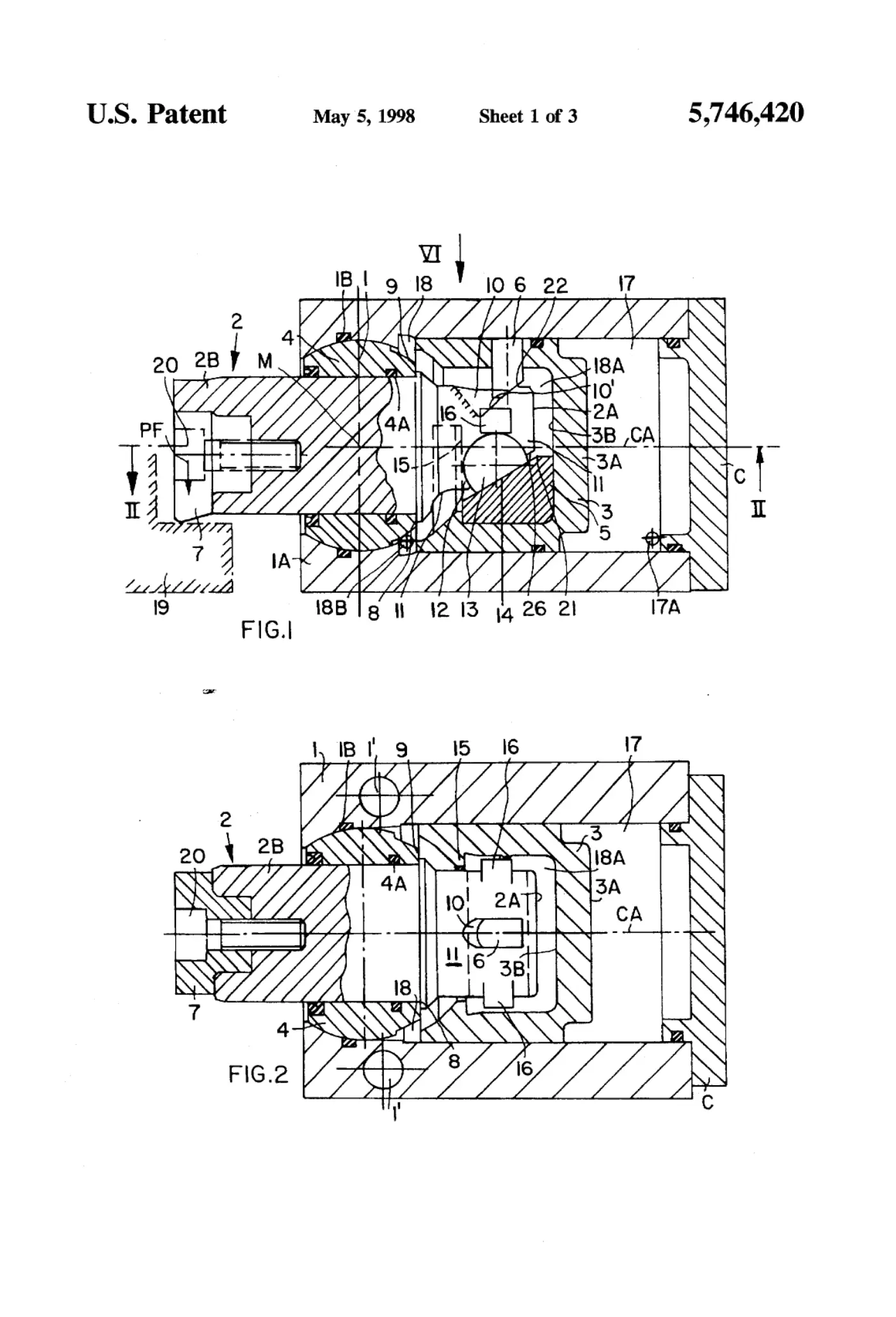
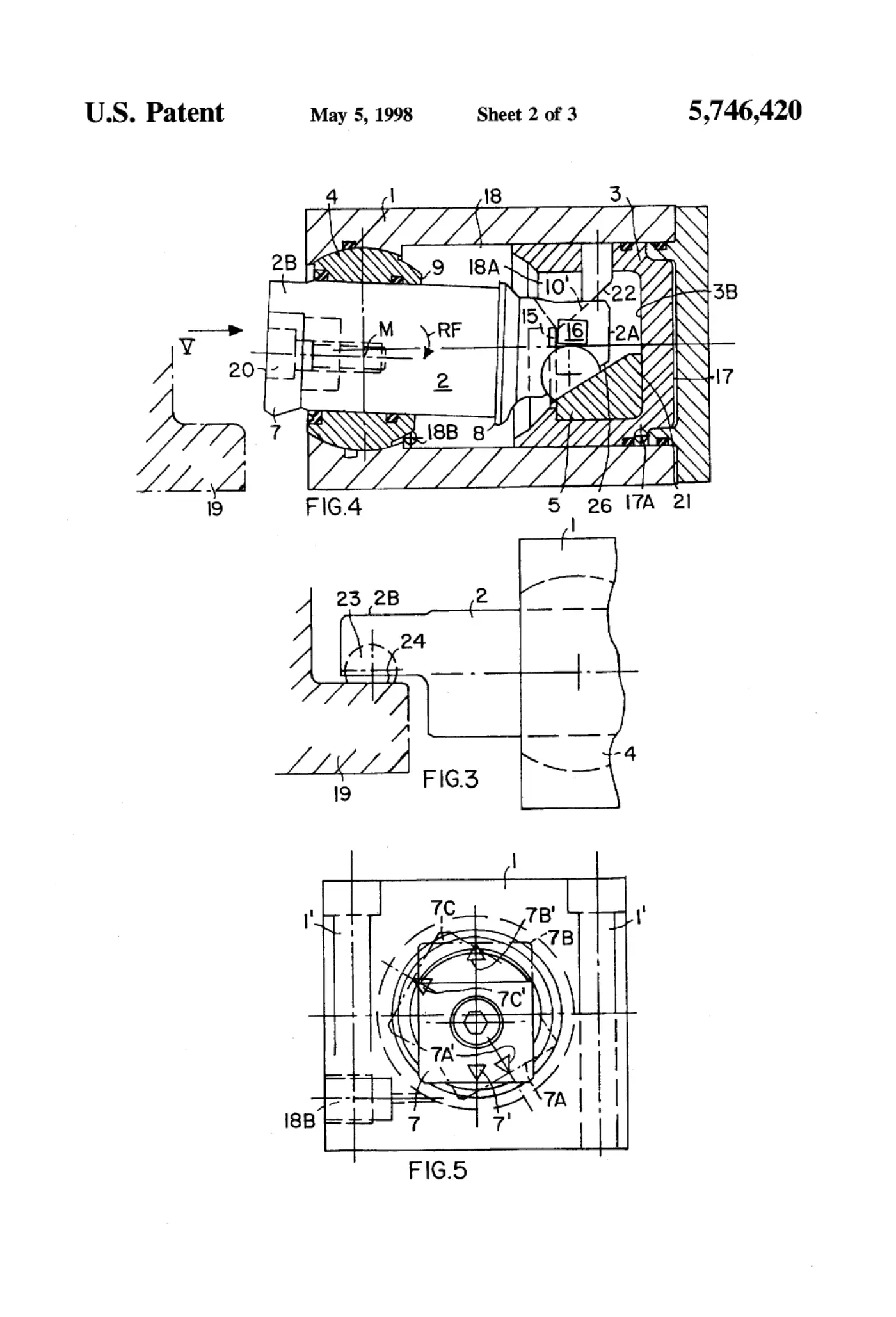
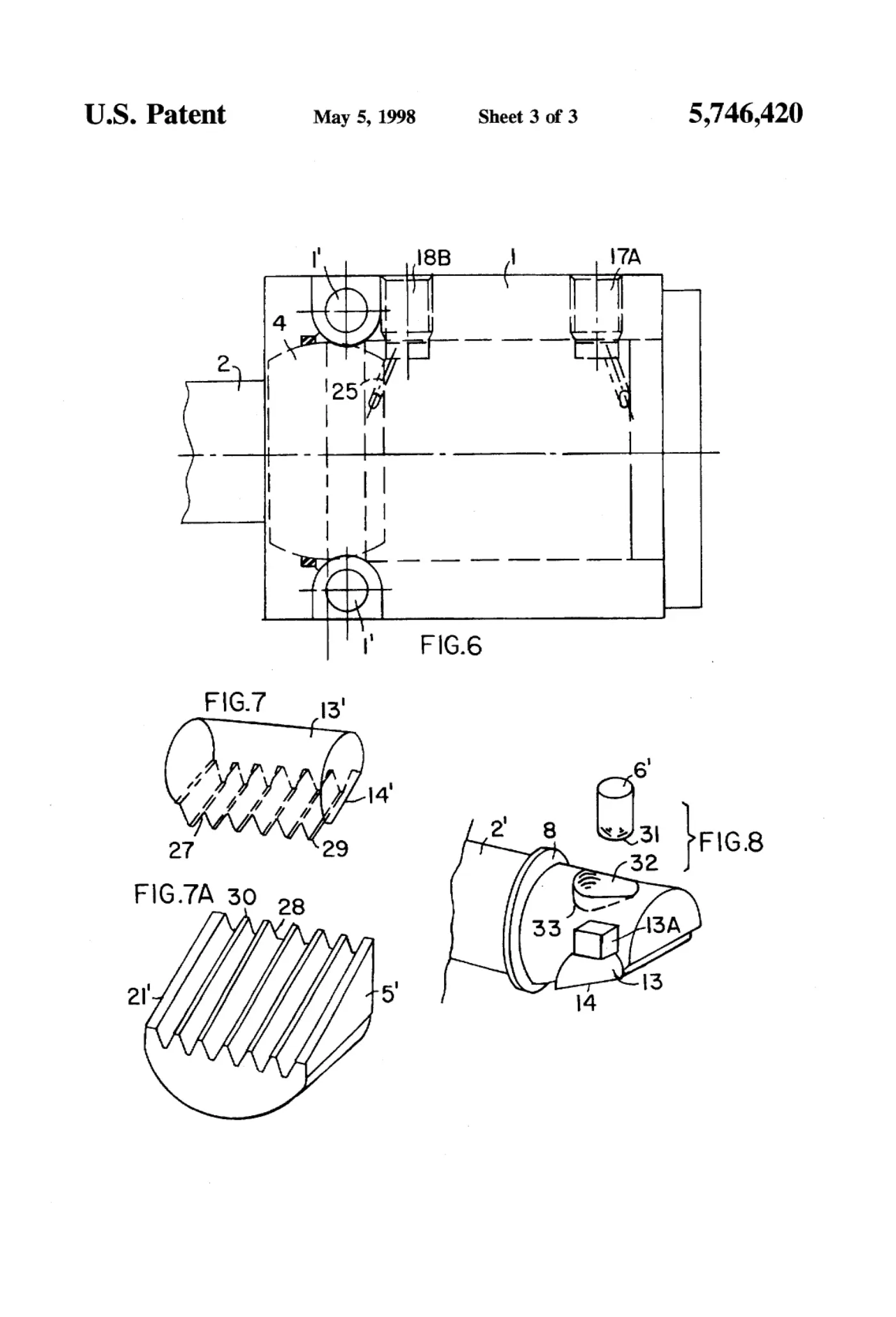
A clamping device for holding, for example a work piece in a machine tool, has a housing with a cylindrical bore and a clamping piston with a dead-end cavity axially slidable in the housing. A clamping lever extends through a ball-bushing with an inner end into the dead-end cavity of the piston and with an outer end carrying a clamping head out of the housing. The inner piston end has a first slanted surface that cooperates with a correspondingly slanted second surface rigidly held in the cavity of the piston. A guide and stop pin also rigidly mounted in the piston cavity cooperates with a recess in the clamping lever to guide an axial movement of the lever relative to the piston and to facilitate a pivoting movement of the lever about the center of the ball-bushing, but simultaneously preventing or stopping a relative rotation between the piston and the lever. Such a structure can be adjusted to apply the clamping force in any direction in a plane extending perpendicularly to the longitudinal axis of the clamping device.
Abstract
A clamping device for holding, for example a work piece in a machine tool, has a housing with a cylindrical bore and a clamping piston with a dead-end cavity axially slidable in the housing. A clamping lever extends through a ball-bushing with an inner end into the dead-end cavity of the piston and with an outer end carrying a clamping head out of the housing. The inner piston end has a first slanted surface that cooperates with a correspondingly slanted second surface rigidly held in the cavity of the piston. A guide and stop pin also rigidly mounted in the piston cavity cooperates with a recess in the clamping lever to guide an axial movement of the lever relative to the piston and to facilitate a pivoting movement of the lever about the center of the ball-bushing, but simultaneously preventing or stopping a relative rotation between the piston and the lever. Such a structure can be adjusted to apply the clamping force in any direction in a plane extending perpendicularly to the longitudinal axis of the clamping device.
1. Drawings
[0001]Sheet 1.
[0002]Sheet 2.
[0003]Sheet 3.
[0004]Sheet 4.
Publication information
Citation
OpenTechnical Publication OT-2026-000003218, “Clamping device for securing a first component, such as a tool, to a second component,” published September 15, 2026 at 19:51:23 UTC, https://opentechnical.org/p/OT-2026-000003218.
To cite specific content, add the paragraph or figure numbers.
Terms
This record reproduces a document published elsewhere and is provided for reference and study. Rights in the original remain with its owner. See the publication policy.