Abstract
This disclosure describes a soft robotic gripper employing a granular jamming mechanism to conform to and grasp objects of varied shapes and stiffness. The gripper features a compliant outer membrane enclosing a volume of granular material, which transitions from a fluid-like state to a rigid solid state upon the application of a vacuum. This mechanism enables controlled, distributed force application, preventing damage to delicate items while providing sufficient grip for rigid components. The system addresses the challenge of handling diverse unpackaged goods within a single automated work cell, where traditional rigid grippers are unsuitable due to their inability to adapt to object variability.
1. Technical Field
[0001]The present disclosure relates to robotic end effectors, specifically to grippers designed for handling objects with variable geometries and mechanical properties in automated systems. More particularly, it pertains to soft robotic gripping mechanisms that utilize a reversible phase transition in a granular material to achieve adaptable and conformable grasping.
2. Technical Context
[0002]Automated handling of diverse items, particularly unpackaged goods or items with irregular shapes, presents a significant challenge in robotics. Traditional robotic grippers, often employing rigid fingers or fixed-geometry suction cups, are designed for specific object types. When faced with a range of objects that may vary in size, shape, surface texture, and deformability (e.g., from delicate produce to robust machined parts), such grippers typically fail to perform reliably. Rigid grippers risk crushing soft items if their grip force is not precisely tuned, or they may fail to secure rigid items if the contact geometry is insufficient. The requirement for a single robotic work cell to handle both delicate, deformable objects and robust, stiff objects necessitates an end effector capable of broad adaptability without complex sensing or control schemes for each item type. This disclosure describes an arrangement that addresses this need by leveraging a soft, conformable material that can be reversibly stiffened.
3. System Overview
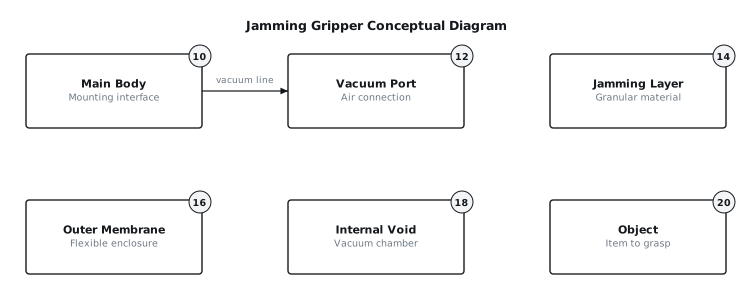
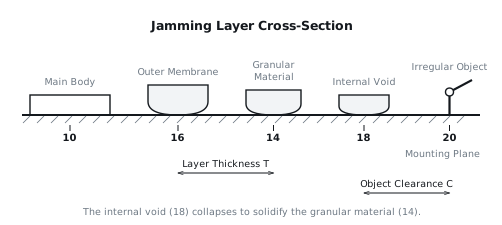
[0003]The described system is a soft robotic gripper that integrates a granular jamming layer for adaptable grasping. The gripper comprises a main body (10) which provides structural support and an interface for connection to a robotic arm. A vacuum port (12) is integrated into the main body (10) to facilitate pneumatic actuation. The core of the gripping mechanism is a flexible outer membrane (16) that encloses a volume of granular material (14), forming the jamming layer. This layer also defines an internal void (18) which is selectively connected to the vacuum port (12). When the internal void (18) is evacuated, the pressure differential compresses the granular material (14), causing it to jam and become rigid. This rigidified layer then conforms to the shape of an object (20) it was previously in contact with, providing a secure, distributed grasp. Upon release of the vacuum, the granular material (14) returns to a fluid-like state, allowing the gripper to release the object (20) and reconfigure for the next task. The arrangement is depicted conceptually in FIG. 1 and in cross-section in FIG. 2.
4. Components
[0004]The primary components of the jamming layer soft gripper include:
[0005]
- Main Body (10): This structural component serves as the mounting interface for connecting the gripper to a robot arm or other motion system. It also houses internal pneumatic channels and provides support for the flexible elements. The main body (10) is typically fabricated from a rigid material such as an aluminum alloy or a stiff polymer.
- Vacuum Port (12): A standard pneumatic fitting, such as a quick-connect or threaded port, integrated into the main body (10). This port provides the connection point for an external vacuum source (not shown) and directs the vacuum pressure to the internal void (18).
- Outer Membrane (16): A flexible, airtight enclosure that defines the external shape of the gripper's active gripping surface. It is designed to be highly conformable, allowing it to deform around irregular objects (20) without tearing or puncturing. Materials for the outer membrane (16) can include silicone, natural rubber, or thermoplastic elastomers, chosen for their elasticity, durability, and tear resistance. The membrane thickness may range from 0.5 mm to 3.0 mm.
- Granular Material (14): This material fills the volume enclosed by the outer membrane (16). It consists of discrete, relatively incompressible particles. Examples include ground coffee, plastic beads (e.g., polystyrene, polypropylene), silica sand, or glass microspheres. The particles are typically spherical or sub-spherical, with a diameter ranging from 0.1 mm to 5.0 mm. The selection of granular material influences the final stiffness of the jammed state, the speed of jamming, and the gripper's overall compliance in the unjammed state.
- Internal Void (18): This is a volume within the outer membrane (16) that is free of granular material (14) and is connected to the vacuum port (12). When vacuum is applied, the pressure differential causes the outer membrane (16) to collapse inwards, compressing the granular material (14) against itself and against the inner surface of the outer membrane (16), initiating the jamming transition. The internal void (18) may be formed by an internal bladder or simply by ensuring the outer membrane (16) encloses the granular material (14) and forms a sealed cavity.
5. Operation
[0006]The operation of the soft jamming gripper involves distinct phases: approach, grasp, hold, and release.
[0007]Start-up and Initialization: Upon power-up, the vacuum source is typically off, and the granular material (14) within the outer membrane (16) is in a fluid-like, unjammed state. The gripper's outer membrane (16) is compliant and deformable, ready to conform to an object.
[0008]Approach and Pre-Contact: The robotic arm positions the gripper such that the outer membrane (16) is brought into contact with or in close proximity to the target object (20). During this phase, the gripper is soft and flexible, allowing it to passively adapt to the general shape of the object (20) without applying significant localized pressure. The unjammed state ensures that even incidental contact with delicate objects does not cause damage.
[0009]Grasping (Jamming Transition): Once appropriate contact or encirclement of the object (20) is achieved, the vacuum source is activated. Air is rapidly evacuated from the internal void (18) via the vacuum port (12). This creates a pressure differential across the outer membrane (16), causing it to collapse inwards and compress the granular material (14). As the volume occupied by the granular material (14) decreases, the particles become tightly packed and interlocked, undergoing a jamming transition. The granular material (14) transforms from a fluid-like state to a rigid, solid-like state, effectively freezing the shape of the outer membrane (16) as it conformed to the object (20). The grip force is applied across the entire contact surface, distributing pressure and securely holding the object (20). The stiffness of the jammed layer provides the necessary structural integrity for manipulation. The maximum grip force is inherently bounded by the atmospheric pressure acting on the effective contact area and the strength of the outer membrane (16), rather than by direct control inputs, preventing excessive force application that could damage fragile items.
[0010]Holding: While the vacuum is maintained, the granular material (14) remains jammed, and the gripper securely holds the object (20). The robot arm can then transport or manipulate the object (20) to its destination. The rigidity of the jammed layer is sufficient to counteract gravitational and inertial forces within the design payload limits.
[0011]Release: To release the object (20), the vacuum source is deactivated, and atmospheric pressure is reintroduced into the internal void (18). This equalizes the pressure differential, allowing the outer membrane (16) to relax and the granular material (14) to unjam and return to its fluid-like, compliant state. The gripper loses its rigidity and the object (20) can be deposited.
[0012]Fault or Failed Grasp: If, during the grasping phase, the gripper fails to establish sufficient contact with the object (20) or if the object (20) is too large or awkwardly positioned, the jamming process will still occur, but the resulting grip may be insufficient. In such a scenario, the gripper's external shape will rigidify in its current state, but the object (20) might not be securely held. A force sensor integrated into the robot wrist (not part of this disclosure) or a pressure sensor within the vacuum line can detect insufficient grip force or improper vacuum levels. Upon detection of a failed grasp, the system initiates a release sequence, unjamming the gripper. The robot arm then retracts the gripper, performs a repositioning maneuver, and attempts the grasp again. This retry mechanism is enabled by the inherent reconfigurability of the jamming layer.
6. Example Embodiments
[0013]Embodiment 1: A single finger gripper intended for small, delicate, or geometrically complex items. The main body (10) is a cylindrical housing, and the outer membrane (16) forms a bulbous, hemispherical shape. The granular material (14) is fine silica sand, approximately 0.2 mm in diameter. The internal void (18) is a small central channel connected to the vacuum port (12). This configuration is suitable for picking individual items from a bin or tray, offering high conformability and minimal impact force.
[0014]Embodiment 2: A two-finger gripper where each "finger" is a separate jamming unit. Each finger comprises an elongated cylindrical outer membrane (16) filled with plastic beads of 1.0 mm diameter. The main body (10) provides a rigid frame to which the two jamming fingers are articulated, allowing them to pivot inward to embrace an object (20). Each finger has its own vacuum port (12) and internal void (18), allowing for independent or synchronous jamming. This arrangement can handle larger or elongated objects, employing a pincer-like grasp where the conformability of the jamming layer is applied to two distinct contact points.
[0015]Embodiment 3: A multi-finger array gripper designed for flat or sheet-like materials, or for covering a large, irregular surface. This embodiment consists of a rigid plate-like main body (10) from which an array of nine smaller, independent jamming "pads" protrudes. Each pad is a flat, rectangular outer membrane (16) filled with ground coffee. Each pad has a dedicated vacuum port (12) and internal void (18), allowing for selective activation. This allows the gripper to conform to localized irregularities on a larger surface, or to pick up multiple small items simultaneously, distributing the load across several independent gripping points.
7. Alternative Configurations
[0016]The described system can be configured with various adaptations. Instead of a single internal void (18), a network of smaller internal channels or an array of interconnected bladders could be embedded within the granular material (14) to achieve more uniform compression and a faster jamming transition. The outer membrane (16) could incorporate internal reinforcement ribs made of a flexible material to control its deformation behavior in the unjammed state, biasing it towards a particular pre-grasp shape. Furthermore, the granular material (14) could be mixed with a small proportion of elastic particles to modify the stiffness and damping characteristics of the jammed state. The vacuum source can be replaced by an external pressure source to inflate an internal bladder, which then compresses the granular material (14) from the inside out, offering an alternative mechanism for achieving the jamming transition.
8. Parameter Variations
| Parameter | Range | Effect of Variation |
|---|---|---|
| Particle Size (d) | 0.1 mm to 5.0 mm | Smaller particles (0.1-0.5 mm) generally lead to higher stiffness in the jammed state and finer surface conformity but can increase jamming time. Larger particles (1.0-5.0 mm) offer faster jamming, but potentially reduced stiffness and contact area resolution. |
| Particle Shape | Spherical to Irregular | Spherical particles facilitate faster unjamming and reconfigurability. Irregularly shaped particles can increase friction and interlocking, potentially leading to higher grip force but may also increase the energy required for unjamming. |
| Membrane Thickness (t) | 0.5 mm to 3.0 mm | Thinner membranes (0.5-1.0 mm) offer higher compliance and faster conformity but have lower tear resistance. Thicker membranes (2.0-3.0 mm) increase durability but reduce sensitivity to fine object details and require higher vacuum for full jamming. |
| Vacuum Pressure (P) | -50 kPa to -95 kPa (gauge) | Higher vacuum pressure (-80 to -95 kPa) increases the compressive force on the granular material, resulting in a stiffer jammed state and higher potential grip force. Lower vacuum (-50 to -70 kPa) yields a softer, more compliant jammed state. |
| Granular Material Volume | 50% to 90% of membrane volume | A higher fill volume (80-90%) generally leads to a more rigid jammed state with less internal void collapse. A lower fill volume (50-70%) allows for greater deformation and conformity to highly irregular shapes but may reduce overall stiffness. |
| Operating Temperature | -10 °C to 60 °C | Extreme temperatures can affect the elasticity of the outer membrane (16) and the flow properties of the granular material (14), influencing jamming speed and overall compliance. Selection of materials must account for the expected range. |
9. Additional Implementations
[0018]The jamming layer described here can be integrated into various robotic systems beyond simple pick-and-place grippers. It can form the active surface of a robotic hand, where each finger segment incorporates a jamming layer, allowing for dexterous manipulation of complex objects. The technology can also be applied to end effectors for collaborative robots, where the inherent compliance in the unjammed state and the force-bounding characteristic of the jammed state contribute to safer human-robot interaction. Furthermore, a planar arrangement of the jamming layer could be used as a reconfigurable support surface for objects, temporarily holding items in place while other robotic operations are performed. The concept can also be scaled up to create large-area conformable tools for tasks such as polishing or sanding irregular surfaces, where the tool's active face needs to adapt to the workpiece geometry. The granular jamming principle could also be extended to fluidic jamming, using a viscous fluid instead of granular particles, where the fluid's viscosity is rapidly increased or decreased through external means, offering another pathway to adjustable stiffness.
10. Figures